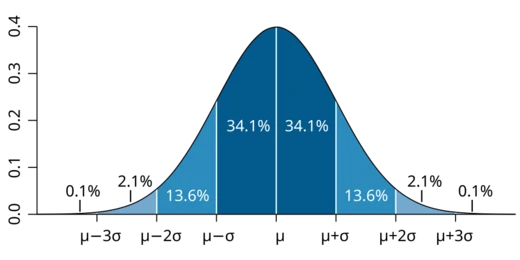
Probability density function
A function giving relative probability per unit length for continuous variables.

In probability theory, a probability density function (PDF), density function, or simply density of an absolutely continuous random variable, is a function whose value at any given point in the sample space can be interpreted as providing a 'relative probability' that the value of the random variable would be equal to that point. Probability density is the probability per unit length. The PDF is used to specify the probability of the random variable falling within a particular range of values, as opposed to taking on any one value. This probability is given by the integral of a continuous variable's PDF over that range. The PDF is nonnegative everywhere, and the area under the entire curve is equal to one.
- field
- Probability theory
- known_for
- Specifying probability of a continuous random variable falling within a range via integral of the density function
Lore & Background
The probability density function is most commonly associated with absolutely continuous univariate distributions. A random variable X has density f_X, where f_X is a non-negative Lebesgue-integrable function, such that Pr[a ≤ X ≤ b] = ∫_a^b f_X(x) dx. If F_X is the cumulative distribution function of X, then F_X(x) = ∫_{-∞}^x f_X(u) du, and (if F_X is differentiable at x) f_X(x) = d/dx F_X(x). Intuitively, one can think of f_X(x) dx as being the probability of X falling within the infinitesimal interval [x, x+dx].
Reader's Guide
The probability density function is a fundamental concept in statistical inference, used to model continuous random variables. Unlike discrete variables, the probability of a continuous variable taking any exact value is zero; instead, the PDF gives the probability per unit length, and the probability over an interval is the area under the curve. The terms probability distribution function and probability function can also denote the PDF, but this use is not standard among probabilists and statisticians. In other sources, 'probability distribution function' may refer to the cumulative distribution function or a probability mass function, leading to confusion. The PDF is distinct from the probability mass function, which is used for discrete random variables. Both are essential in statistical inference.
Did You Know?
- The value of the PDF at two different samples can be used to infer how much more likely the random variable is to be close to one point compared to the other.
- The probability that a bacterium dies between 5 hours and 5.01 hours is quantifiable; in one example, it is 0.02, giving a probability density of 2 hour⁻¹ at around 5 hours.
- The Radon–Nikodym derivative provides a formal measure-theoretic definition of the density of a random variable with respect to a reference measure.
More in Probability And Stochastic Processes 1-21
Spotted an error? Know more?
This is a living reference — every entry is fact-audited, and reader corrections feed straight into our audit queue. Suggest an edit · See this site's audit record