Variance
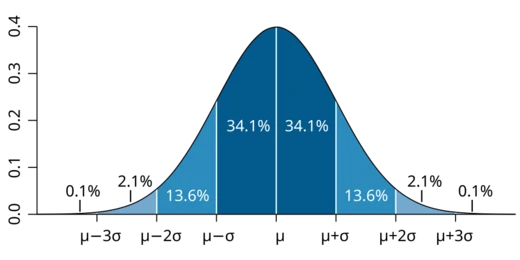
Variance measures how far numbers spread from their average.

Variance is a measure of dispersion in probability theory and statistics, defined as the expected value of the squared deviation from the mean of a random variable. It is the second central moment of a distribution and the covariance of the random variable with itself. Variance is often represented by symbols such as σ², s², Var(X), V(X), or 𝕍(X).
- field
- Probability theory and statistics
- known_for
- Measure of dispersion; expected value of squared deviation from the mean; second central moment; covariance of a random variable with itself
Lore & Background
Variance is defined as the expected value of the squared deviation from the mean of a random variable X, with μ = E[X]. It can be expanded as E[X²] − (E[X])². The standard deviation is the square root of the variance. An advantage of variance is its amenability to algebraic manipulation; for example, the variance of a sum of uncorrelated random variables equals the sum of their variances. A disadvantage is that its units differ from the random variable, unlike the standard deviation, and it is not finite for many distributions.
Reader's Guide
There are two distinct concepts both called 'variance.' One is part of a theoretical probability distribution and defined by an equation. The other is a characteristic of a set of observations, typically measured from a real-world system. If all possible observations are present, the calculated variance is called the population variance; if only a subset is available, it is called the sample variance, which estimates the full population variance. The two kinds are closely related: if an infinite number of observations are generated using a distribution, the sample variance from that infinite set matches the distribution's equation for variance. Variance has a central role in statistics, including descriptive statistics, statistical inference, hypothesis testing, goodness of fit, and Monte Carlo sampling.
Did You Know?
- Variance is defined as the expected value of the squared deviation from the mean of a random variable.
- The standard deviation is the square root of the variance.
- Variance is the second central moment of a distribution and the covariance of the random variable with itself.
- A disadvantage of variance is that its units differ from the random variable, unlike the standard deviation.
More in Probability And Stochastic Processes 1-21
Spotted an error? Know more?
This is a living reference — every entry is fact-audited, and reader corrections feed straight into our audit queue. Suggest an edit · See this site's audit record