Central limit theorem
A theorem on the convergence of sample means to normality.

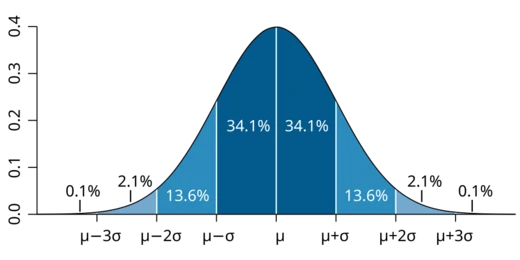
The central limit theorem (CLT) is a fundamental concept in probability theory. It states that, under appropriate conditions, the distribution of a normalized version of the sample mean converges to a standard normal distribution, even if the original variables themselves are not normally distributed. The theorem is a key concept because it implies that probabilistic and statistical methods that work for normal distributions can be applicable to many problems involving other types of distributions.
- field
- Probability theory, statistics
- known_for
- Describing the convergence of the sample mean distribution to a normal distribution
- modern_form_stated
- 1920s
Lore & Background
The central limit theorem has seen many changes during the formal development of probability theory. The earliest version of this theorem, that the normal distribution may be used as an approximation to the binomial distribution, is the de Moivre–Laplace theorem.
Reader's Guide
The central limit theorem is a cornerstone of statistical inference. In its classical form, it states that for a sequence of independent and identically distributed random variables with finite mean and variance, the distribution of the normalized sample mean approaches a normal distribution as the sample size increases. This holds regardless of the shape of the original distribution. The theorem's significance lies in its justification for using normal distribution-based methods on data from other distributions, provided the sample size is large enough. The requirement of independence and identical distribution can be weakened under certain conditions. The theorem describes the size and distributional form of stochastic fluctuations around the population mean during convergence, with the scaled difference between sample mean and population mean converging to a normal distribution with mean zero and variance equal to the original variance.
Did You Know?
- The central limit theorem states that the distribution of a normalized version of the sample mean converges to a standard normal distribution.
- The earliest version of the theorem is the de Moivre–Laplace theorem, which approximates the binomial distribution with a normal distribution.
- The requirement for the random variables to be independent and identically distributed can be weakened under certain conditions.
More in Probability And Stochastic Processes 1-21
Spotted an error? Know more?
This is a living reference — every entry is fact-audited, and reader corrections feed straight into our audit queue. Suggest an edit · See this site's audit record